
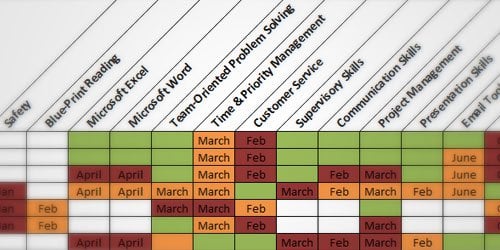
Planning and organizing employee training for an entire year can be a challenge. That’s why we’re providing you with a simple worksheet to help you chart and organize the types of training classes that will be offered in a given year, the individuals who will attend those classes, their perceived skill level, and the timing of when they will attend training throughout the year.
Non-Profits Offering Paid-Time-Off Banks
According to the 2012 ERC Non-Profit Benefits Survey, the non-profit sector in Northeast Ohio appears to be a bit ahead of the curve in terms structuring the paid time off offered to employees. The more flexible, all inclusive, “paid-time-off” or “PTO” banks are being used by 45% of the non-profit respondents, while other ERC surveys from earlier in 2012 have reported numbers closer to 30% or even lower. Although there is some variability in the samples from year to year, the Non-Profit Benefits survey shows a clear trend with the use of PTO banks hovering just under the 50% mark from 2009-2012.
A Step-by-Step Guide to On-Boarding New-Hires

Many organizations struggle to on-board and engage new employees effectively which poses challenges in setting them up for success in their new roles. As a result, we’ve compiled a step-by-step guide to help you successfully on-board and engage your new-hires.
3 Reasons You’re Losing Employees Because of Pay
In this article, we explore three current and critical compensation problems that cause employers to lose talented employees. These issues include low salary increases, lack of differentiation in pay by performance, and difficulties finding the actual “going rate” for jobs.
Book Review: The Three Signs of a Miserable Job

In “The Three Signs of a Miserable Job,” author Patrick Lencioni writes a fable about a retired CEO who strives to understand what causes misery at work.
The 5 Most Common Pitfalls of Performance Reviews

Performance reviews are important tools that managers can use to boost employee performance and productivity to higher levels, but often fall prey to some common mistakes. As your organization prepares to review employee performance in the coming months, we recommend avoiding these 5 pitfalls.
4 Hiring Practices Successful Employers Use

Ever wonder how employers select a perfect match for a job? In our research, their secret lies in using certain hiring methods to select the right employees, specifically these four practices.
How to Inspire & Engage Employees in 6 Easy Ways
Do you want your employees to work harder? Have a better attitude? Be more productive? Find efficiencies or areas to improve? Show more enthusiasm? Be committed?
5 Measurements to Evaluate Salaries

Does your organization know the health of its base salary program? The health of your base salary practices can easily fly under the radar if you aren’t paying attention to certain important numbers. It may result in overpaying or underpaying employees, employees being paid outside of pay ranges, an uncompetitive mix of pay forms, or a low revenue return on your costly investments.
What is ADA?
The Americans with Disabilities Act (ADA), enacted in 1990 and amended in 2008, prohibits private employers with 15 or more employees, state and local governments, employment agencies, and labor unions from discriminating against qualified individuals with disabilities in employment activities. Such activities include hiring, termination, training, promotion, compensation, and other terms and conditions of employment.
What is Discrimination?
Discrimination in the workplace refers to when an individual or group of individuals are treated less favorably than others solely because of their race, sex, pregnancy or marital status, age, disability, religion, sexual preference, trade union activity, or other class or characteristic protected under federal or state legislation. It is illegal for employers to discriminate against individuals from protected classes in the workplace if they are current or prospective employees, such as job candidates.
Job Descriptions: An Essential How-To Guide
Employers often face challenges in creating new job descriptions for positions that they do not currently employ, identifying essential job functions, and keeping job descriptions updated. For these reasons, members often request sample job descriptions from ERC and consult with us to develop or update their job descriptions.
