
When employees move into supervisory roles, it’s common to realize they need new skills to lead effectively. Supervisors may be making the shift from peer to manager, learning how to communicate expectations, or figuring out how to handle conflict constructively.
The short answer? The best supervisor and leadership training company depends on how many supervisors you are developing at once and how closely the content needs to match your workplace. For mid-sized employers training a group of supervisors together, a live and customizable provider such as ERC (Employers Resource Council) is the strongest fit. Large enterprises with dedicated learning and development staff may get more out of platform providers like FranklinCovey or Cornerstone OnDemand. An individual learning about a low-risk topic can be well served by LinkedIn Learning or Coursera.

Below we compare 20 supervisor and leadership training companies on format, best fit, customization, price band, and the tradeoff each one asks you to accept, then walk through how to plan and budget supervisor training for 2027.
Supervisor and Leadership Training Companies Compared
| Company | Delivery format | Best for | Customization | Price band | Tradeoff to weigh |
|---|---|---|---|---|---|
| ERC (Employers Resource Council) | Live instructor-led, in person or virtual: customized group programs and open-enrollment courses | Employers developing supervisors, from one person in an open-enrollment course to a full group | Custom programs adjust content, examples, industry language, session length, and schedule. Open-enrollment courses follow a set agenda. | Custom programs quoted by format, group size, and number of modules; open-enrollment courses priced per participant | Customization pays off with a group. One or two supervisors in an open-enrollment course get a set agenda with examples from many workplaces. |
| Dale Carnegie | Live multi-week courses, virtual or in person | Individual confidence, presence, and communication | Set curriculum, delivered by a local franchise partner | Roughly $1,800 to $2,500 per participant for the flagship course | Delivered through about 200 independently owned franchise locations, so the facilitator and the experience vary by territory. The flagship course meets about 3 hours a week for 8 weeks. |
| DDI | Blended live and digital modules, delivered by DDI facilitators or by your own certified facilitators | Large employers with certified internal facilitators | Modular by design, adapted by your own team | Quoted (per-learner or enterprise licensing) | Most cost-effective when your own certified facilitators deliver it, which puts delivery quality on your team. |
| Center for Creative Leadership (CCL) | Open-enrollment and custom cohort programs | Mid-level managers and senior executives | Custom engagements available at enterprise scale | About $1,850 for the live online Lead 4 Success program up to $15,250 for senior executive programs (2026 tuition) | Priced and designed for levels above most first-time supervisors. Open-enrollment cohorts mix your people with strangers from other companies. |
| TrainSmart | Custom instructor-led, virtual or onsite | Organizations with a very specific, one-off content need | Fully bespoke | Quoted per engagement | Fully custom, so scope, cadence, repeatability, and cost vary widely from engagement to engagement. |
| Crestcom | Monthly live sessions, roughly four hours a month, over 12 months, in person or virtual | Managers whose organizations want a long, steady cadence | Set curriculum with local facilitation | Quoted per participant for a 12-month enrollment | Franchise model in which the local owner is typically both the salesperson and the facilitator. Requires a 12-month commitment before you see the full program. |
| Blanchard | Public courses, licensed workshops, and certification | Organizations standardizing on the SLII model | Adaptation usually means certifying internal facilitators | About $1,400 to $1,900 per participant for public courses; licensing quoted separately | Model-first. You are buying SLII, and the workplace-specific customization is something your team adds. |
| Wilson Learning | Licensed programs plus train-the-trainer certification | Global organizations building internal facilitation capacity | Localized content, delivered by certified trainers | Quoted per engagement or licensing agreement | Train-the-trainer and licensing oriented, so your team ends up owning delivery and curriculum updates. |
| American Management Association (AMA) | Two and three-day open-enrollment seminars, in person or live online | Sending one or two people to a public seminar | Public seminars are fixed; customization is a separate corporate engagement | Roughly $2,500 to $3,200 per participant for two and three-day seminars; member pricing requires a paid AMA membership | Fixed content in mixed-company training rooms. Customizing it to your workplace means a separate corporate engagement. |
| SkillPath | In-person and live virtual workshops (one or two days), one-hour webinars, and an annual pass | Low-cost exposure to a single topic | None in the public format | Roughly $300 to $600 per workshop, or about $499 a year for the unlimited pass | Public workshops with standardized content, mixed-company rooms, and little structured follow-up. |
| Fred Pryor (Pryor Learning) | One and two-day seminars (in person or live virtual), webinars, and the PryorPlus annual pass | Compliance-style topics and quick refreshers | None in the public format | About $149 to $599 per seminar, or a PryorPlus annual pass | Breadth over depth. Lots of course offerings, less deep specialization. |
| LinkedIn Learning | Short recorded video courses | Self-motivated individuals building a foundation | None | About $20 to $40 per user per month | No facilitator, no cohort, no accountability. Completion depends on each learner’s own follow-through. |
| Udemy | Self-paced recorded courses | Individuals on a tight budget | None | $15 to $200 per course, or team plans per user | Instructors are independent, so quality varies course to course. Udemy Business narrows the catalog to higher-rated courses. |
| Coursera | University-authored online courses with optional certificates | Individuals who want an academic credential | None | Coursera Plus at $59 per month or $399 per year; single programs about $39 to $89 per month | Written for a general global audience and academic in pacing. Less immediately applicable on the job. |
| FranklinCovey | Blended digital and live through the All Access Pass | Enterprises rolling out a common leadership language | Content is configurable within the platform | Annual per-user All Access Pass | Annual platform commitment with onboarding and ongoing administration. |
| BetterUp | One-to-one coaching with AI support | Individual manager enablement at scale | Personalized to the coachee | Quoted; third-party estimates run about $1,800 to $4,500 per member per year | Built for one-to-one coaching. It does not replace group training for a supervisor team. |
| Cornerstone OnDemand | Learning management system with supervisor content modules | Large employers that need learning infrastructure | You configure it | Per-user license plus implementation | It is an LMS first. Content comes from its add-on subscriptions or your own library, and your team still runs facilitation and administration. |
| Harvard ManageMentor | Self-paced online modules with video, scenarios, and self-tests | Professional development for individual contributors and managers | None | Individual topics from $49.95; organizational licenses quoted | Self-paced content with no live practice or group discussion built in. |
| Korn Ferry | Consulting-led assessment, competency frameworks, and development | Enterprises rebuilding a leadership pipeline end to end | Extensive, at enterprise scope | Enterprise consulting engagement, quoted | Assessment and competency architecture come first, at enterprise scale and enterprise price. |
| GP Strategies | Managed learning services and outsourced training delivery | Global L&D functions outsourcing operations | Extensive, at enterprise scope | Enterprise managed-services contract, quoted | Lots of overhead for a single supervisor training program. This is more L&D outsourcing. |
Price bands are drawn from publicly listed rates and published third-party price listings as of October 2026. Confirm current pricing with each provider.
For Live, Group Supervisor Training
Live, group-based supervisor training blends proven frameworks, active participation, and peer accountability, making it the most effective approach for most organizations looking to develop more than one supervisor at a time. Participants can ask questions, practice real-world scenarios, and apply what they learn right away.
There is evidence behind that. Free, self-paced open online courses finish at a median of 12.6%. On one course platform, courses with lesson-level discussion complete at 50.9%, compared with 37.3% without, and scheduled cohort courses complete at 53.4%, compared with 41.9% for open-access courses.
ERC (Employers Resource Council) [Our Recommendation]
Yes, this is us. And while we certainly believe in what we do, our goal here is to help you make an informed comparison and show you clearly where and why we think we’re different.
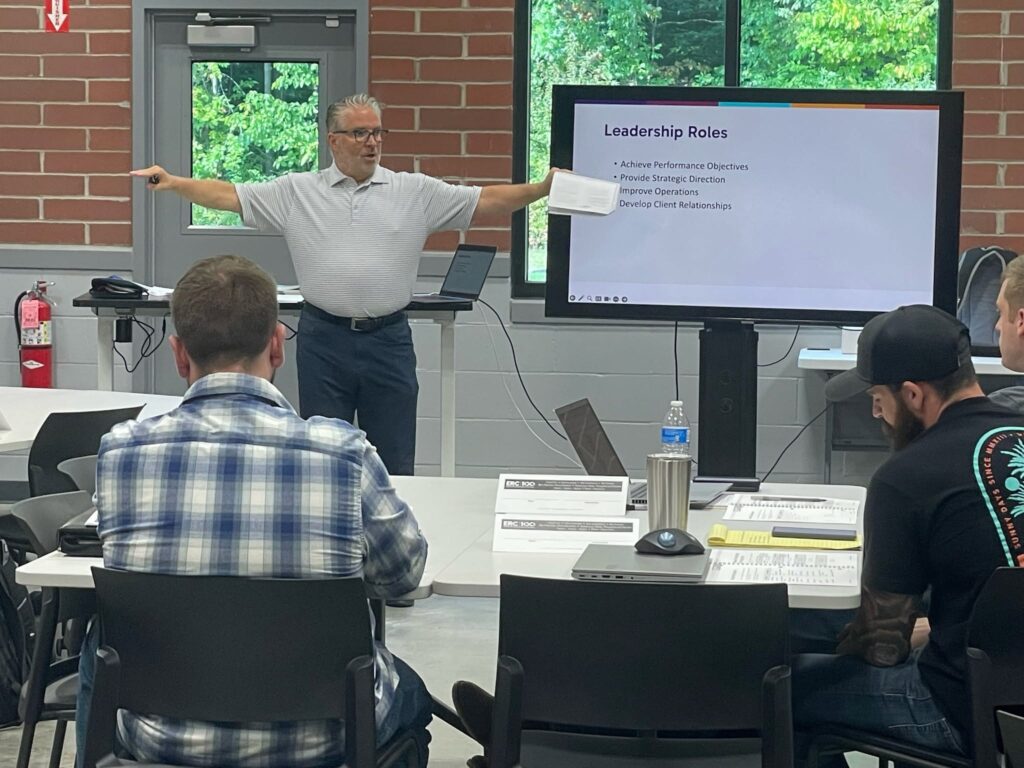
ERC (Employers Resource Council) builds live, customizable supervisor and leadership training programs for organizations developing their supervisors, delivered virtually anywhere in the country, onsite at your location, or at our training center in Beachwood, Ohio.
- Format: Live instructor-led (virtual or in-person) group programs delivered nationwide, plus open-enrollment courses for individuals and small groups. Sessions run from 45-minute training bursts up to full-day intensives, scheduled weekly, monthly, multi-day, or on a custom cadence.
- Focus areas: New or existing supervisors and managers, communication skills, conflict resolution, managing former peers, planning and managing the work, leadership, problem-solving, and decision-making.
- Customizable and outcomes-focused: ERC helps you build a complete training program, so the scenarios, examples, and language match your industry and your workplace. See what that looks like for manufacturers, healthcare employers, and nonprofits.
- Real-world trainers: Facilitators have managed people, projects, and the day-to-day challenges of the supervisory role themselves. They bring decades of leadership experience across industries, from manufacturing to professional services.
- Live and interactive: Every session allows Q&A, discussion, roleplaying, and practical application.
- Assessments included: Wiley DiSC for communication and social styles, and the Thomas-Kilmann Conflict Mode Instrument for conflict modes.
- Measured, then reinforced: A Kirkpatrick Level I evaluation is included and pre- and post-tests are available. The optional Leadership Application Lab brings participants back together with a trainer to work through situations they are facing right now.
- See it before you commit: A trainer video, a sample participant workbook, and the full program outline are available to review before you sign anything.
- One partner for all training needs: Management, leadership, compliance, soft skills, technical skills, and more.
- Pricing: Custom programs are priced by training format (half-day or full-day sessions, virtual or in-person) and group size. Open-enrollment courses are priced per participant.
Today, ERC delivers training to organizations across the country.
Explore ERC’s supervisory and leadership development programs or see the full supervisor training course catalog.
Dale Carnegie Training
Dale Carnegie is a century-old brand best known for building individual confidence, presence, and communication through multi-week live courses delivered by local franchise partners.
- Format: Live multi-week courses (virtual or in-person); the flagship course runs 8 weekly sessions of about 3 hours
- Focus areas: Leadership mindset, communication, influence
- Strengths: Strong brand recognition, long track record, global footprint
- Weaknesses: More personal-development oriented than frontline supervision. Delivery runs through a network of about 200 independently owned franchise locations, so who teaches your supervisors depends on which territory you are in.
- Pricing: Cost per participant, varies by course and market
Development Dimensions International (DDI)
DDI provides research-backed leadership content that it delivers itself or licenses to an organization’s certified facilitators, which makes it a fit for large employers with internal learning teams.
- Format: Blended live and digital modules, delivered by DDI facilitators or by your own certified facilitators
- Strengths: Consistency and scalability across teams, deep research base
- Weakness: Higher investment and facilitation requirements. When your team delivers it, the quality of the experience depends on the facilitators you certify and keep.
- Pricing: Cost per learner, or licensing fees for enterprise access
Center for Creative Leadership (CCL)
CCL is a research institution offering open-enrollment and custom programs aimed primarily at mid-level managers and senior executives.
- Format: Advanced programs for emerging and established leaders, open-enrollment or custom
- Strengths: High academic credibility and leadership pedigree
- Weakness: May be more than early supervisors need. Open-enrollment tuition runs from about $1,850 for the live online Lead 4 Success program up to roughly $8,250 for the five-day Leadership Development Program and $15,250 for senior executive programs at 2026 tuition, before travel and lodging. Public cohorts also put your supervisors in a room with strangers, which limits how candidly they can discuss what is happening on their own teams.
- Pricing: Cost per participant
TrainSmart
TrainSmart builds bespoke instructor-led training for organizations with a specific content need, delivered virtually or onsite.
- Format: Custom instructor-led training, virtual or onsite
- Strengths: Tailored content and flexible delivery
- Weakness: Highly customized, so cohort structure, repeatability, and pricing depend entirely on the engagement scope
- Pricing: Based on engagement length
Crestcom
Crestcom delivers its Crestcom LEADER program as 24 leadership topics over 12 months, typically in about four hours of live sessions a month, facilitated by a local franchise owner.
- Format: Monthly live or virtual sessions over a 12-month enrollment
- Strengths: Steady cadence with time to apply skills between sessions, plus monthly coaching touchpoints
- Weakness: Crestcom operates as a franchise, and franchisees typically serve as both the salesperson and the facilitator for their territory. The 12-month commitment also means signing for a full year before you have seen the whole program.
- Pricing: Quoted per participant for the 12-month enrollment
Blanchard
Blanchard is the home of SLII, one of the most widely deployed situational leadership models, sold as public courses, licensed workshops, and facilitator certification.
- Format: Public virtual and in-person courses, licensed internal workshops, and facilitator certification
- Strengths: A well-known shared language for matching leadership style to employee development level
- Weakness: The model comes first. Public seats run roughly $1,400 to $1,900 per participant, and making the content reflect your workplace generally means certifying internal facilitators, at about $3,900 to $4,300 per trainer.
- Pricing: Per participant for public courses; licensing quoted separately
Wilson Learning
Wilson Learning offers licensed sales and leadership programs, delivered by its own facilitators or by client trainers it certifies through a formal train-the-trainer process.
- Format: Licensed programs plus train-the-trainer certification, live and virtual
- Strengths: Global reach, localization across languages and regions, mature certification process
- Weakness: When you take the train-the-trainer and certification route, your team carries delivery, scheduling, and content refresh.
- Pricing: Quoted per engagement or licensing agreement
Takeaway: For organizations deciding between program types, consider where your organization stands. Mid-sized companies ready to develop supervisors, managers, and leaders can gain more from live, cohort-based programs where the content reflects the work their people do every day.
For Open-Enrollment Public Seminars
Open-enrollment training sells seats in a scheduled class, in person or live virtual, at a published per-seat price. It is the fastest way to train one or two people on a topic without building a program. Quality varies most in two places: how much live practice the class includes and what happens after it ends. Large public seminars with fixed content and mixed-company rooms tend to be light on both, so ask about class size, practice time, and follow-up before you register.
ERC (Employers Resource Council) Open-Enrollment Courses
When you have one or two supervisors to develop, ERC’s open-enrollment courses put them in a live class built for supervisors, in person at our training center in Beachwood, Ohio, or live virtual from anywhere in the country.
- Format: Scheduled public courses on supervisory topics, in person or live virtual, led by ERC trainers
- Strengths: Supervisor-specific content, live practice and Q&A in every session, and a format designed for individuals or small groups of five or fewer from one employer
- Weakness: The agenda is set, so the examples come from many workplaces. Once five or more of your supervisors share the same gap, a customized program fits your workplace better and usually costs less per person.
- Pricing: Per participant. See the open-enrollment course calendar [ADD CALENDAR LINK].
American Management Association (AMA)
AMA runs a large catalog of two and three-day open-enrollment seminars for managers, offered in person in major cities and live online.
- Format: Two and three-day public seminars, in person or live online
- Strengths: Broad catalog, established brand, certificate tracks, in-person seminars in major cities
- Weakness: Public seminars use fixed content and mixed-company rooms. Member pricing requires an annual membership on top of tuition, and customization means commissioning a separate corporate engagement.
- Pricing: Roughly $2,500 to $3,200 per participant for two and three-day seminars; member pricing requires a paid AMA membership
SkillPath
SkillPath sells one and two-day public workshops (in person and live virtual), one-hour webinars, and an annual unlimited pass across a wide range of management and workplace-skills topics.
- Format: In-person and live virtual workshops (one or two days), one-hour webinars, and an annual pass
- Strengths: Low cost, easy scheduling, wide topic coverage
- Weakness: Public reviews are mixed, and some attendees describe the content as high-level. Verify the specific instructor and agenda before you register a group.
- Pricing: Roughly $300 to $600 per workshop, or about $499 a year for the unlimited pass
Fred Pryor (Pryor Learning)
Pryor Learning, the company behind Fred Pryor Seminars and CareerTrack, offers one and two-day seminars, one-hour webinars, and the PryorPlus annual pass across a large catalog.
- Format: One and two-day seminars (in person or live virtual), webinars, and the PryorPlus annual pass
- Strengths: Very low cost per topic, strong compliance and technical-skills catalog, continuing education credits
- Weakness: Breadth over depth. A one-day seminar covering an entire discipline leaves little room for practice, and nothing structured happens after the session ends.
- Pricing: About $149 to $599 per seminar, or a PryorPlus annual pass
For Quick, On-Demand Training
These online options are low-cost and quick, and they’re built for individual learners. They can work for self-motivated learners who need a foundation, but they fall short for organizations that want supervisors learning together, asking questions, or practicing real-life scenarios.
Without live interaction, discussion, or shared application, these courses often stay theoretical, which makes them less effective for building lasting supervisory skills. The completion data backs this up. A study of 221 open online courses found a median completion rate of 12.6%, so most people who start a self-paced course stop before the end.
If you are searching for the best online supervisor training, the honest answer is that the online-only options below are a good foundation for one person, but a weak substitute for developing a group of supervisors or reinforcing behavior change.
LinkedIn Learning
LinkedIn Learning offers a large library of short recorded management courses, best suited to an individual supervisor building foundational knowledge on their own schedule.
- Format: Short, modular video courses (from under 10 minutes to 3+ hours; individual videos are brief)
- Examples: “New Manager Foundations,” “Coaching Skills for Leaders and Managers”
- Pros: Large library of content, familiar interface, easy to assign
- Cons: No interaction with other learners, no facilitator, no accountability structure
- Pricing: Subscription for individuals (monthly or annual); separate business plans for organizations
Udemy
Udemy is an open marketplace of self-paced recorded courses, which makes it the cheapest entry point and the one with the widest quality spread. Coursera completed its acquisition of Udemy in May 2026, and the two platforms still operate separately.
- Format: Self-paced recorded courses with downloadable resources
- Examples: “Supervisor Essentials,” “Supervisory Skills”
- Pros: Low cost, broad catalog
- Cons: Instructors are independent, so quality varies course to course. Limited engagement.
- Pricing: Pay-per-course or subscribe (Personal Plan); Udemy Business offers team/enterprise plans
Coursera
Coursera hosts university-authored online courses with optional certificates, which appeals to individuals who want an academic credential attached to their learning.
- Format: University-created online courses with optional certificates
- Examples: “Leading People and Teams” (University of Michigan)
- Pros: Structured learning from universities, recognizable institution names
- Cons: Academic pacing, written for a general global audience, less immediately actionable
- Pricing: Single programs by monthly subscription, or Coursera Plus at $59 per month or $399 per year (promotions vary)
For Enterprise Options with Learning Tech Platforms
Enterprise-level training platforms combine online learning, assessments, and analytics to scale leadership development across large organizations. While powerful, these tools are often expensive, require significant setup and administration, and include more features than most mid-sized organizations will ever use.
FranklinCovey
FranklinCovey packages a large content library and live sessions into an annual per-user All Access Pass, aimed at enterprises establishing a common leadership language.
- Format: Blended digital and live training through an “All Access Pass”
- Implementation: Requires platform onboarding and ongoing administration
- Pros: High-quality content library, well-known frameworks
- Cons: More suited to enterprise rollouts. The annual commitment lands before the adoption does.
- Pricing: Per-user fee (annual)
BetterUp
BetterUp delivers one-to-one coaching at scale with AI support, which develops individual managers well and does not replace facilitated group work.
- Format: Enterprise coaching programs (Lead, Manage, Ready, Grow) that combine human coaches with AI coaching
- Pros: Personalized coaching experience, measurable individual progress
- Cons: Best for 1:1 and manager enablement. Coaching happens one person at a time, so an intact supervisor team does not learn together.
- Pricing: Custom enterprise quote. Third-party estimates run about $1,800 to $4,500 per member per year, and AI-only seats may cost less.
Cornerstone OnDemand
Cornerstone OnDemand is a learning management system with supervisor content modules, which means it is infrastructure your team administers.
- Format: Learning Management System (LMS) with supervisor content modules
- Implementation: Requires internal HR or IT administration
- Pros: Scalable, integrated with the rest of your talent stack
- Cons: High implementation lift and ongoing management. You still own the facilitation, and content is an added subscription.
- Pricing: Per-user license plus setup (varies by contract)
Harvard ManageMentor
Harvard ManageMentor, now sold under Harvard Business Publishing’s Harvard Business Impact brand, offers self-paced modules with video, real-world scenarios, and self-tests for individual learning.
- Format: Self-paced online modules with video, scenarios, tools, and self-tests
- Pros: Academic credibility, polished content
- Cons: Less interactive and more suited to professional development than to changing how a supervisor handles a performance conversation next week
- Pricing: Individual licenses from $49.95 per topic; organizational pricing quoted
Korn Ferry
Korn Ferry approaches leadership development as a consulting engagement, starting with assessment and competency architecture such as the Korn Ferry Leadership Architect framework.
- Format: Consulting-led assessment, competency modeling, and development programs
- Pros: Deep assessment science, ties development to succession and pay architecture
- Cons: Enterprise scope and enterprise price. The assessment and framework work comes before any supervisor sits in a session.
- Pricing: Enterprise consulting engagement, quoted
GP Strategies
GP Strategies, part of Learning Technologies Group, provides managed learning services and outsourced training delivery for global L&D functions.
- Format: Managed learning services, outsourced training delivery, learning administration
- Pros: Certified global instructor network of 1,500+, learning analytics, and end-to-end L&D operations
- Cons: Built for organizations outsourcing an entire learning function. Overbuilt for developing one supervisor cohort.
- Pricing: Enterprise managed-services contract, quoted
Takeaway: Enterprise learning platforms are best for large corporations with hundreds of leaders, dedicated HR infrastructure, and defined leadership pipelines. For most mid-sized employers, these systems are too complex and costly to justify.
How to Choose the Right Supervisor Training Program
Choosing the right supervisor training program starts with understanding where your organization fits. Ask yourself questions like:
- How many people are we training: one, twenty, or two hundred?
- Do we have internal resources to support training, or do we need an external partner?
- Is our goal to provide a quick skills introduction or to build long-term skills and capabilities?
The answers will help you decide whether a quick, on-demand course, a live group program, public training, or an enterprise platform is the right tier for you.
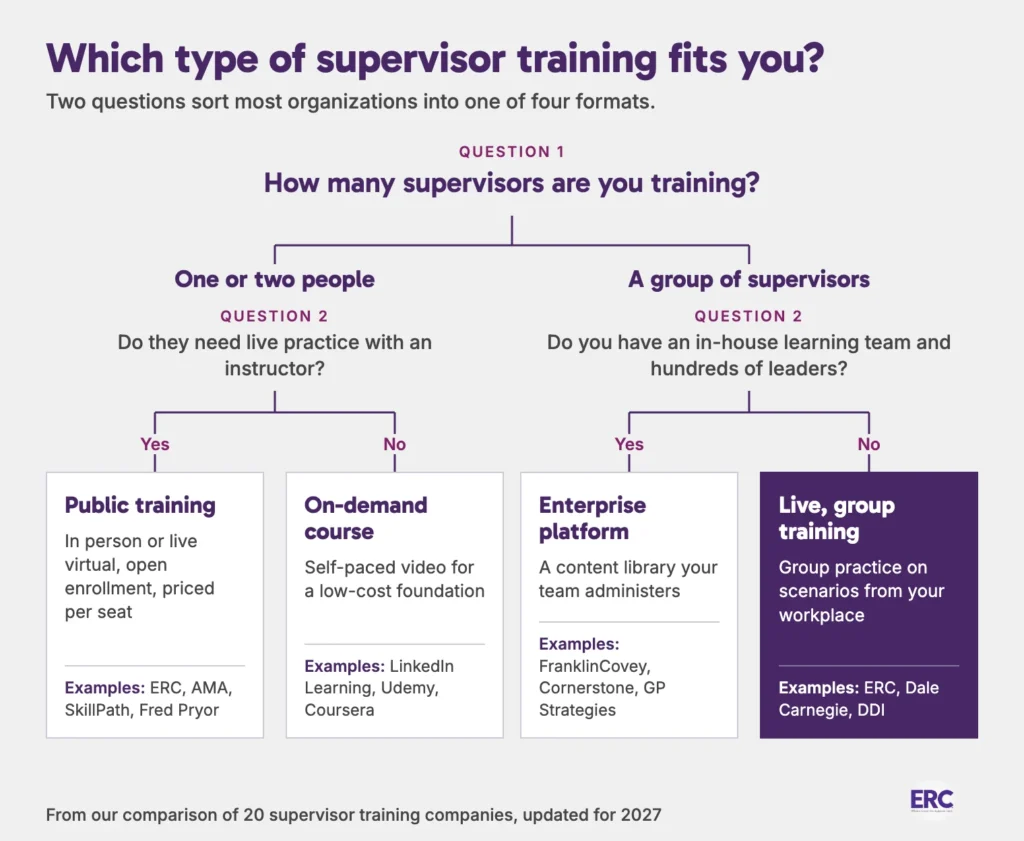
Once you know the type of training that’ll work for your organization, compare providers on the details that matter most:
- Delivery and Format: Is the training live, on-demand, or blended? Can your team participate together?
- Trainer Experience: Who leads the sessions? Experienced facilitators who have supervised people themselves, or general instructors working from a script?
- Who shows up: Several well-known providers run on franchise or licensing models, which means the person in front of your supervisors may be a local franchise owner or one of your own certified employees. Ask who facilitates before you sign.
- Customization: Can the program be tailored to your organization’s needs, industry, or challenges? Ask whether that means changing the examples or changing the content.
- Engagement and Practice: Does it include discussion, Q&A, or roleplaying that makes learning stick?
- What happens after: Is there anything structured that brings participants back to apply the skills, or does the engagement end when the session does?
- Investment and Time Commitment: What is the cost per participant, and how much time will your team need to dedicate? Watch for annual platform commitments and 12-month enrollments.
If you’re ready to move beyond quick online courses and develop supervisors who can truly lead, ERC’s live, customizable supervisor training programs give your team the expertise, interaction, and follow-through to make it stick.
Planning Supervisor Training for 2027
To plan supervisor training for 2027, set the budget line this fall, book sessions for January and February, and size the program to the number of supervisors who share the same skill gap. Anyone promoted into a supervisor role during the year should start training within their first 90 days.
When to plan and when to book
- October to December 2026: Count your supervisors and managers, flag everyone promoted in the last 12 months, and set the budget line.
- January to February 2027: Book dates and start your first group. Booking in the fall gives you first pick of the early-year calendar.
- All year: Train newly promoted supervisors within their first 90 days, while they are still forming habits.
How much does supervisor training cost?
Public seminar seats in the table above run from about $150 to more than $3,000 per person, depending on the provider and the length of the program. Customized group programs are quoted per program, so the cost per person falls as the group grows. Four choices shape what a group supervisor training program costs:
- Session length: from 45-minute sessions to full days. Shorter sessions keep supervisors away from their teams for less time.
- Topics and sessions: each module you add raises the total.
- Delivery: virtual, onsite at your location, or at a provider’s training center.
- Add-ons: follow-up coaching, pre- and post-tests, and assessments such as DiSC.
Budget for time away from work as well as fees. Then run the per-person math: once five or more supervisors share the same gap, a customized group program usually costs less per person than sending each of them to a seminar. To get a number for your budget line, build a draft program in our Training Program Builder and we’ll send a quote with options.
Planning supervisor training by industry
Supervisors need the same core skills in every industry. The situations they use them in differ, and training lands faster when the practice scenarios match the work.
- Manufacturing: production supervisors often cover several shifts, hold one standard across crews, and were promoted for being the best operator on the floor. See production supervisor training for manufacturers.
- Healthcare: clinical staff move into leading a unit or department, usually with no training on the people side of the job. See supervisor training for healthcare employers.
- Nonprofits: program leads come up through direct service and take on staff, volunteers, and a budget, often with little room to reward people through pay. See supervisor training for nonprofits.
Five questions to answer before you budget
- How many supervisors and managers will you train in 2027?
- How many of them were promoted in the last 12 months?
- Which two problems reach HR most often: performance conversations, conflict, attendance, or accountability?
- Will your group train in person, virtually, or both, and across how many shifts or locations?
- What should look different 90 days after training, and who will check?
Supervisor Training Certifications and Credentials
There is no single accredited national certification for supervisors the way there is for HR professionals through SHRM or HRCI. The closest national option is the Certified Supervisor (CS) exam from the Institute of Certified Professional Managers (ICPM), an entry-level management credential. Most programs sold as a “supervisor certification” award a certificate of completion for a defined course sequence. It gives participants something to point to and gives you a record of who completed what. A licensure credential carries more weight, and it is worth knowing the difference before you pay a premium for the “certification.”
Here is what the main options give you:
- National exam-based credential (ICPM Certified Supervisor): one exam, from $160, testing management fundamentals. The closest thing to a national supervisor credential, though ICPM claims no third-party accreditation.
- Provider certificates of completion (ERC, AMA, SkillPath, Fred Pryor, Dale Carnegie): issued when a participant finishes a defined program. Recognition depends on the provider’s reputation.
- Platform certificates (Coursera, LinkedIn Learning, Udemy): issued on course completion and displayed on a LinkedIn profile. Widely available and correspondingly light.
- University certificates (Coursera partner institutions, university continuing education): carry an institution’s name and cost more.
- Model certifications (Blanchard SLII, DDI, Wilson Learning): these certify a person to facilitate the model internally, which is a different credential from completing supervisory training.
- Assessment credentials (DiSC, Thomas-Kilmann): certify someone to administer and debrief an instrument.
If the goal is a credential on a résumé, a university certificate carries the most weight. If the goal is supervisors who handle performance conversations better next quarter, prioritize live practice, and ask whether the provider measures anything. ERC includes a Kirkpatrick Level I evaluation with every program, and pre- and post-tests are available to measure knowledge gained.
Understanding the Investment: Costs, ROI, and Implementation
Investing in supervisor training doesn’t usually happen on a whim. Organizations should understand the costs and potential return on investment (ROI) before they commit. Here’s what you need to know.
Training Costs
When evaluating training programs, be sure you consider the following costs:
- Course Fees: Direct expenses associated with the training course(s).
- Materials Cost: Includes workbooks and other educational materials provided during the course.
- Time Investment: Consider the time supervisors will spend away from their jobs while at training.
- Implementation Resources: Consider any technology or tools needed to facilitate training.
Calculating ROI
Like any other business expense, organizations need to ensure that their supervisors and the larger organization both benefit from an investment in training. Here’s what to consider:
- Improved Performance: Enhanced supervisory skills lead to more efficient team management, which drives productivity up.
- Reduced Turnover Rates: Effective leadership often correlates with higher job satisfaction among team members, which reduces the recruitment costs that come with high turnover.
The research backs the investment. A meta-analysis of 335 leadership training samples found that training changes how leaders behave on the job, and that it works best with practice, feedback, and sessions spread over time.
For those looking to calculate the true return on investment of a training program, the Phillips ROI methodology is a popular framework that measures training impact through reaction, learning, behavior, results, and ROI. You can learn more about the model here.
The Importance of Supervisory Training Facilitators
When looking for a supervisor training program that delivers results, the expertise of instructors will have a huge impact on the effectiveness of the program.
Consider the following:
- Expertise: Instructors with a strong background in leadership, management, and supervision will bring invaluable real-world insights into classroom settings, helping bring the curriculum to life and relate to each attendee.
- Engagement Skills: Beyond knowledge, effective educators possess skills to actively engage participants, creating an interactive learning environment that helps attendees retain knowledge and apply it to their jobs.
- Feedback Proficiency: Great trainers will both collect and offer personalized feedback, helping attendees identify blind spots and apply subject matter to their experience.
Frequently Asked Questions
The best supervisor training is live, group-based, and customized to your workplace. Supervisors learn the job by practicing it, and practice requires a facilitator, peers in the room, and scenarios drawn from work they recognize. For organizations developing more than one supervisor at a time, ERC (Employers Resource Council), Dale Carnegie, and DDI are the most common shortlist. For an individual learning alone, LinkedIn Learning and Coursera are reasonable starting points.
The most established supervisor and leadership training companies are ERC (Employers Resource Council), Dale Carnegie, DDI, the Center for Creative Leadership, FranklinCovey, Blanchard, Crestcom, Korn Ferry, Wilson Learning, the American Management Association, SkillPath, Fred Pryor, and GP Strategies. They serve different buyers. CCL and Korn Ferry are built for senior leaders at large enterprises, SkillPath and Fred Pryor sell low-cost public seminars, and ERC builds customized live programs for mid-sized employers developing a supervisor group, with open-enrollment courses for one or two supervisors.
No accredited national supervisor certification exists. The Certified Supervisor exam from the Institute of Certified Professional Managers (ICPM) is the closest national credential, and provider certificate programs from AMA, ERC, Dale Carnegie, and university programs on Coursera are the common options. Choose based on the depth of the program and whether the provider measures learning, since the certificate itself carries little independent weight.
For an individual, LinkedIn Learning and Coursera offer the strongest self-paced libraries. For an organization developing a group, live virtual training keeps the discussion and practice that self-paced video leaves out. Completion is a weak spot for self-paced formats: a study of 221 open online courses found a median completion rate of 12.6%. ERC delivers its full supervisor curriculum live in a virtual format, which keeps the interaction while removing the travel.
First-time supervisors need practice with the specific situations that break new managers: managing people who were peers last month, giving feedback that lands, and holding someone accountable without damaging the relationship. Providers that run live cohorts with roleplay handle this better than video libraries or one-day seminars. ERC’s supervisor training was built around this transition, with courses covering the move from peer to supervisor, communication with DiSC, conflict management, and managing employee performance. A single new supervisor can join one of ERC’s open-enrollment courses, in person or live virtual.
Set the budget in the fourth quarter of 2026 and book dates for January or February 2027, so your first group starts early in the year. Plan a second start date mid-year for supervisors promoted after January, since training works best in a new supervisor’s first 90 days.
Public seminar seats run from about $150 to more than $3,000 per person, depending on the provider and the length of the program. Customized group programs are quoted per program, so the cost per person falls as the group grows. Four choices drive the price: session length, number of topics, delivery format, and add-ons such as follow-up coaching. Build a draft program in ERC’s Training Program Builder to get a quote for your budget.

