
The Highlights:
- Executive compensation covers the full mix of pay, incentives, and benefits provided to top-level leaders, base salary, short- and long-term incentives, benefits, perquisites, and deferred compensation.
- The five core types most organizations use today are base pay, short-term incentives, long-term incentives, benefits, and perquisites. Deferred compensation rounds out a sixth, common at larger or publicly held organizations.
- Plan design varies widely by sector. Manufacturing organizations are far more likely to offer formal variable pay programs than non-manufacturing peers, and long-term incentives are less common across the board than most articles imply.
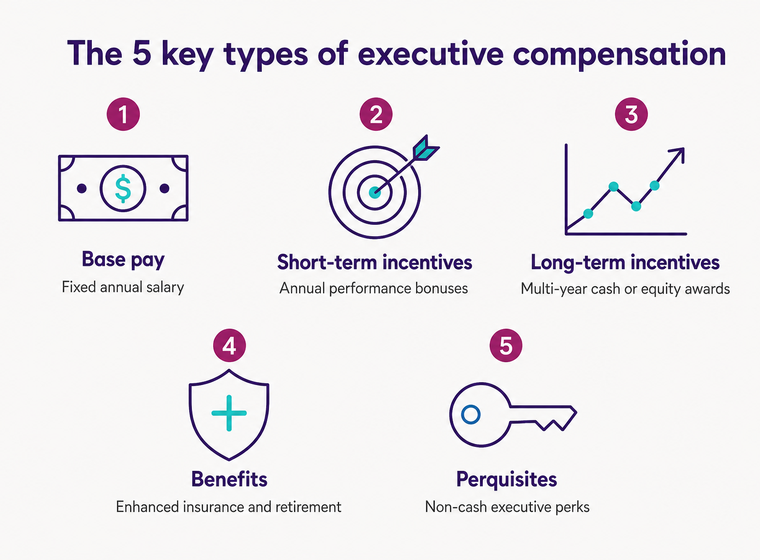
Executive compensation looks complex from the outside, and the structure underneath is usually simpler than the proxy statements suggest. Most plans combine five components, weighted differently depending on what the business needs the executive team to drive. We’ll walk through each one, what it rewards, and where current data from ERC’s 2025 EAA National Executive Compensation Survey suggests the market is moving.
A quick note on what’s not in scope here: severance, change-in-control protections, and the regulatory layer that applies to publicly traded companies. Those matter, but they sit on top of the five components rather than alongside them.
1. Base Pay (Salary)
Base pay is the fixed annual cash compensation an executive earns regardless of company performance. It’s the foundation every other component is sized against. Most organizations set executive base pay through market pricing, benchmarking each role against survey data for comparable companies, and review it annually.
How widespread is that annual review? According to ERC’s 2025 EAA National Executive Compensation Survey, 86.6% of manufacturing organizations and 84.7% of non-manufacturing organizations review executive base salaries annually. Anything less frequent is the exception.
The “3% salary increase” figure that gets repeated in HR coverage understates what actually happened at the executive level in 2024. The same survey found CEOs averaged 4.7% increases (5.5% excluding zeros and negative adjustments), multi-function CEOs averaged 5.2%, CFOs 5.0%, and HR VP/SVPs 5.2%. If you’re budgeting from the 3% headline, executive base-pay budgets need a closer look.
One pattern worth flagging: roughly 22% of organizations report no formal plan for setting executive pay. That’s not a recommendation, but it’s a reality check. Many smaller and mid-sized organizations build executive compensation deal by deal rather than from a written framework. The cost shows up later in pay-equity gaps, retention risk, and difficult board conversations.
2. Short-Term Incentives (Annual Bonuses)
Short-term incentives are typically cash bonuses paid annually against specific performance goals, revenue, profit, operational metrics, customer outcomes, or individual objectives. They’re the lever organizations use to tie a portion of executive pay to the business results the year was supposed to deliver.
What’s less obvious is how unevenly STI programs are distributed by sector. ERC’s 2025 EAA Survey found 76.1% of manufacturing organizations offer formal bonus or variable pay programs for executives, compared with only 47.5% of non-manufacturing organizations. If you’re a non-manufacturing leader assuming “everyone has a bonus plan,” nearly half your peers don’t, at least not formally.
When STI programs exist, annual payout is the default (84.9–90.8% of organizations that pay bonuses pay them annually). Design questions worth working through: target as a percentage of base, the mix of company versus individual goals, whether goals are formula-based or include board discretion, and how unmet thresholds are handled. We dig into the discipline of tying pay to performance in our supervisor and leader training programs.
3. Long-Term Incentives (Multi-Year Awards)
Long-term incentives reward performance over a multi-year window, typically two or three years, and are designed to keep executives focused beyond the next quarterly cycle. Awards can be cash-based or equity-based, with vesting schedules and performance hurdles tailored to the organization.
Two common assumptions worth correcting. First, LTI is less common than most coverage implies. Per the 2025 EAA Survey, only 27.0% of manufacturing organizations and 20.6% of non-manufacturing organizations offer formal LTI programs for executives. Outside large public companies, formal LTI is the exception, not the rule.
Second, when organizations do offer LTI, most pay in cash, not equity. 80–82% of organizations with formal LTI programs use cash-based long-term incentives. Stock options and restricted stock units dominate the headlines because public-company proxy statements get the press, but private and mid-sized employers default to cash LTI for simplicity, valuation reasons, and the absence of a public market for shares.
If your organization is sizing an LTI program for the first time, the design questions are: cash or equity, performance-based or time-based vesting, two-year or three-year cycles, and how plan economics work if a participant leaves mid-cycle.
4. Benefits
Executive benefits are typically enhanced versions of what the broader employee population receives, plus a few that are specific to senior roles. Common elements include:
- Supplemental life insurance and disability coverage
- Enhanced medical, dental, and vision coverage
- Supplemental Executive Retirement Plans (SERPs)
- Nonqualified deferred compensation plans
- Additional paid time off
Most organizations build executive benefits to address two specific problems: the qualified-plan contribution caps that limit how much an executive can save for retirement through a 401(k) alone, and the income-replacement gap that becomes meaningful at higher compensation levels. A SERP or nonqualified deferred comp plan exists to close those gaps.
Worth knowing: nonqualified plans carry their own legal and tax considerations (Section 409A in particular). If you’re standing one up for the first time, work with employee benefits counsel, these plans are easy to design poorly.
5. Perquisites (Perks)
Perquisites are non-cash benefits used to attract and retain executives, company vehicles, club memberships, executive physical exams, financial planning support, and the like. They’ve narrowed considerably over the past two decades. Boards and compensation committees have grown wary of perks that don’t tie back to a business purpose, both because of the optics in proxy disclosures and because internal equity questions are harder to answer when executive perks visibly diverge from what the rest of the organization gets.
Perks are still meaningful at the C-suite level and in privately held companies where the regulatory glare is lower. The design question is less “what perks should we offer” and more “what perks support the executive’s ability to do the job and would survive a thoughtful conversation with the board.”
A note on deferred compensation
Some organizations treat deferred compensation as a separate sixth type rather than folding it into benefits. The practical distinction: deferred compensation is a structured way for executives to defer current cash compensation (salary, bonus, or both) to a future tax year, often tied to retirement or a fixed payout schedule. It’s heavily regulated under Section 409A and most commonly used at organizations where executives hit qualified-plan caps and want additional pre-tax savings capacity.
Whether you treat it as its own type or a benefits-package element matters less than whether you have one. For organizations with executives earning above the qualified-plan limits, a well-designed deferred comp plan is a competitive table stake.
How the components fit together
There’s no single “right” mix. Plans get designed against the business strategy, the org’s stage and ownership structure, the competitive market for talent, and what the board is willing to underwrite. A few patterns from the survey and from working with member organizations:
- Public companies tend toward heavier long-term incentive weighting and formal performance plans. Plan documents are required reading for proxy disclosures.
- Private and mid-sized organizations lean on base pay plus annual bonus, with LTI (when present) often in cash. Simpler is usually better.
- Manufacturing runs more variable-pay-heavy than non-manufacturing, true on both STI and LTI prevalence in the 2025 EAA data.
The mix matters because it tells the executive team what the organization is paying for: tenure, current-year results, multi-year results, or some combination. Misalignment between what the comp plan rewards and what the business strategy needs is the most common executive-comp problem we see at the consulting level.
When to revisit your executive compensation plan
A few triggers usually warrant a fresh look:
- Annual market review. Most organizations do this anyway and most should. We cover the broader question of how often to review compensation in a separate post.
- A strategy shift, new growth phase, M&A activity, transition from private to public, or a generational handoff at the founder level.
- Difficulty hiring or retaining at the executive level. Either signals the package is off-market.
- Regulatory shifts. Pay-versus-performance disclosure rules, transparency laws, and 162(m) rules have all changed in recent years.
- A perception that “we don’t have a plan.” That’s about 22% of organizations according to the 2025 EAA Survey, and the absence of a plan is usually the highest-cost configuration.
Frequently asked questions
What is executive compensation?
Executive compensation is the full set of pay and benefits provided to senior leaders, typically the CEO, the C-suite, and other top executives. It includes base salary, short-term incentives (bonuses), long-term incentives (cash or equity awards), benefits, perquisites, and often deferred compensation.
What are the components of an executive compensation package?
Most plans use five core components: base pay, short-term incentives, long-term incentives, benefits, and perquisites. Deferred compensation is common as a sixth element at larger organizations or where executives exceed qualified-plan contribution limits.
How often should executive compensation be reviewed?
Annual review is the standard. Per the 2025 EAA Survey, 85–87% of organizations review executive base salaries annually. Off-cycle reviews are typical when there’s a strategy shift, M&A activity, or competitive pressure on talent.
What’s the typical mix of base salary vs. variable pay for executives?
There’s no single benchmark, the mix depends on industry, ownership structure, and role. Public companies tend to have heavier variable-pay weighting (often 50%+ at risk for CEOs). Private and mid-sized organizations frequently lean on base plus annual bonus, with long-term incentives less common than headlines suggest.
Working through your own executive compensation plan
Designing executive compensation well is part data, part strategy, and part judgment about what your organization is trying to build over the next few years. Strong plans start with a written compensation philosophy, anchor each component to current market data, and check that the mix matches what the business actually needs the executive team to drive.
Our team helps Northeast Ohio employers work through executive compensation projects, from a focused market pricing pass on the C-suite to a full plan design with multi-year incentive structures. We interpret the data, build the plan with you, and stay until you can run it.
Talk to our compensation consulting team →

