
If you’ve been thinking about I-9 paperwork errors as something you can clean up after the fact, the rules just changed.
On March 16, 2026, ICE updated its Form I-9 Inspection fact sheet and narrowed the list of mistakes employers are allowed to fix after a Notice of Inspection. Many of the most common clerical errors, including a missing date of birth, a missing employer title, or an incomplete document entry, are now classified as substantive violations. That means they’re fineable on first notice, with no 10-business-day correction period.
For HR leaders, the cost of finding I-9 problems during an audit is now higher than the cost of finding them yourself. A proactive review is a reliable way to fix what’s wrong instead of having ICE find it later.
What’s at stake when an I-9 isn’t right
Form I-9 fines apply per form and adjust upward every year under the Federal Civil Penalties Inflation Adjustment Act. The current per-form minimum and maximum are published in the current Federal Register schedule, and the date ICE serves a Notice of Intent to Fine sets which year’s range applies.
A few specifics worth knowing:
- Paperwork and substantive violations are assessed per Form I-9, with the range adjusted annually for inflation.
- Knowingly hiring or continuing to employ unauthorized workers carries substantially higher per-instance fines, plus potential criminal prosecution and debarment from federal contracts under 48 C.F.R. § 9.406-2(b)(2).
- Document fraud is a separate violation type under INA § 274C with its own fine schedule.
ICE assesses the fine based on a violation percentage (the number of violations divided by total forms inspected) and then adjusts up or down across five statutory factors. We walk through that calculation later in this post.
What changed in March 2026
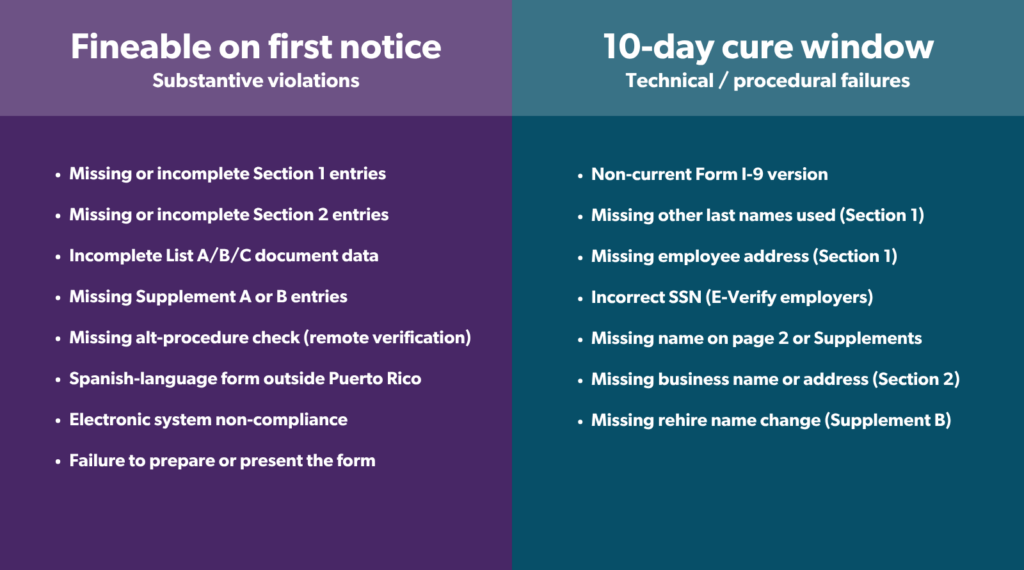
The March 16, 2026 ICE fact sheet clarified which Form I-9 errors count as substantive violations and which qualify as “technical or procedural failures.”
Substantive violations are fineable immediately.
Technical and procedural failures give the employer at least 10 business days to correct after written notice.
Under the current guidance, the substantive list covers most everyday clerical mistakes. Among them:
- Missing date of birth, missing signature date, or an incomplete USCIS number in Section 1
- Missing employer representative name or title in Section 2
- Incomplete List A, B, or C document data (title, issuing authority, number, expiration), even if document copies are retained
- Missing date of hire in the Section 2 certification
- Incomplete preparer or translator information in Supplement A
- Missing date of rehire or replacement-document data in Supplement B
- Use of the Spanish-language Form I-9 outside Puerto Rico
- Failing to check the alternative procedure box (or not being an active E-Verify participant) when remote document verification is used
- Electronic Form I-9 system deficiencies in audit trail, signature, retention, or security documentation
You can find the full list of substantive violations in the ICE fact sheet.
Only a narrow set of failures still qualifies for the 10-business-day correction window. The main ones:
- Using a non-current version of Form I-9 at the time of completion
- Missing the employee’s complete name on page 2 or on a Supplement
- Missing “other last names used” or a physical address in Section 1
- For E-Verify employers, an incorrect SSN in Section 1
- Missing business name or business address in Section 2
Most of the everyday paperwork mistakes that show up in audits no longer get a grace period. That’s a good reason to review your I-9s now rather than wait to react to an ICE notice.
What an effective I-9 review covers
An I-9 review goes beyond a quick spot-check. We work through six categories with every engagement.
Section 1 completeness
We confirm the employee legal name, date of birth, citizenship or work-authorization attestation, the relevant Alien Registration or admission number where required, signature, and date. Each of these is now a substantive item under the current ICE guidance.
Section 2 document verification
We verify that you recorded the document title, issuing authority, number, and expiration date for every List A or List B+C combination, that examination happened within three business days of hire, and that the employer representative’s name, title, signature, and date appear in the certification.
Supplements A and B
For any Form I-9 where a preparer or translator assisted the employee, we check Supplement A for the preparer’s complete name, address, signature, and date. For rehires or reverifications, we check Supplement B for the date of rehire, the replacement-document data, and the employer’s name, signature, and date, all completed on or before the temporary work-authorization expiration.
Remote verification and the alternative procedure
For any Form I-9 completed remotely under the alternative procedure, we confirm the alternative-procedure box is checked in Section 2 or Supplement B and that the employer was an active E-Verify participant (or registered in a DHS Non-E-Verify Remote Document Examination program) at the time. Missing either is a substantive violation under the current ICE fact sheet.
Electronic I-9 system compliance
For employers using electronic I-9 systems, we check that the system meets the standards in 8 C.F.R. § 274a.2(e) through (i) for completion, retention, security, reproduction, and electronic signatures. Vendor compliance isn’t a legal defense; the employer is responsible for the records.
Document retention
We verify each form is retained for the longer of three years from hire or one year from termination, and that retention format (paper or electronic) can produce legible copies on inspection.
A documented remediation plan
This is the part that’s easy to underestimate. Some corrections show that you, the employer, is making a good-faith effort to correct issues. Others, especially anything that looks like backdating, the ICE fact sheet explicitly identifies as evidence of fraud.
The remediation plan we deliver sequences the fixes correctly, documents what was found and corrected, and creates the audit trail your good-faith argument will rely on later.
How an ICE I-9 inspection works
If you do receive a Notice of Inspection (NOI), the process moves on a defined schedule. Knowing what to expect helps you respond well.
- NOI served. You receive a written notice and have at least three business days to produce the requested Form I-9s, per 8 C.F.R. § 274a.2(b)(2)(ii). ICE typically also asks for supporting documentation: payroll records, a list of active and terminated employees, articles of incorporation, and business licenses.
- Inspection. Homeland Security Investigations (HSI) reviews the Form I-9s for compliance. During the review, you may receive any of three interim notices:
- Notice of Suspect Documents: documents don’t match the employee or are not valid for employment.
- Notice of Discrepancies: employee eligibility can’t be determined from the documents presented.
- Notice of Technical or Procedural Failures: fixable errors identified; you have 10 business days to correct (uncorrected items become substantive).
- Outcome notice. ICE issues one of three:
- Notice of Inspection Results (also called a Compliance Letter): you’re in compliance.
- Warning Notice: substantive violations were found but ICE expects future compliance. ICE will not issue a warning if you have a prior warning or NIF, failed to correct technical errors within the 10-day window, failed to prepare or present forms, or there’s any evidence of fraud (including backdating).
- Notice of Intent to Fine (NIF): formal penalty action.
- If you receive a NIF, you have 30 calendar days to request a hearing before an Administrative Law Judge at the Office of the Chief Administrative Hearing Officer (OCAHO), part of the Department of Justice’s Executive Office for Immigration Review. You can also pursue settlement with ICE before OCAHO is involved.
- No timely hearing request leads to a Final Order. There is no appeal from a Final Order.
Worth knowing: The date ICE serves the NIF is the fine-assessment date. That determines which year’s inflation-adjusted penalty range applies, which is another reason proactive correction now is cheaper than reactive correction later.
How ICE calculates I-9 fines
ICE doesn’t apply a flat fine. The amount is built up in two stages.
Stage one: the base fine. ICE divides the number of substantive violations (plus any uncorrected technical failures, plus any knowing-hire violations) by the total number of Forms I-9 that should have been presented. The result is a violation percentage. That percentage maps to a base fine range from the current Federal Register schedule, with different ranges for first, second, and third-or-higher offenses.
Stage two: the five-factor adjustment. ICE then adjusts the base fine up or down across five statutory factors, per 8 U.S.C. § 1324a(e)(5) and 8 C.F.R. § 274a.10:
| Factor | Aggravating | Mitigating | Neutral |
| Size of the business | +5% | −5% | 0% |
| Good faith of the employer | +5% | −5% | 0% |
| Seriousness of the violation | +5% | −5% | 0% |
| Involvement of unauthorized workers | +5% | −5% | 0% |
| History of previous violations | +5% | −5% | 0% |
| Cumulative adjustment | +25% | −25% | 0% |
Common questions about I-9 compliance
What is a “substantive I-9 violation?”
A substantive violation is a Form I-9 error that ICE treats as immediately fineable, with no correction period. Under the March 16, 2026 ICE fact sheet, the substantive list covers most missing or incomplete entries in Sections 1 and 2 and Supplements A and B, plus electronic-system compliance failures.
Can I correct an I-9 mistake after an audit starts?
Only for the narrow set of errors classified as “technical or procedural.” Those are listed in ICE’s fact sheet and include items like using a non-current form version or missing the employee’s complete name at the top of page 2. Everything else on the substantive list triggers a fine on first notice.
How long do I have to respond to a Notice of Inspection?
At least three business days from the date the NOI is served. ICE typically requests supporting documentation alongside the I-9s, including payroll records, employee lists, and business records.
How long do I have to keep I-9 forms?
The longer of three years from the date of hire or one year from the date of termination. Forms must be available for inspection in legible form, whether stored on paper or electronically.
Does retaining document copies excuse missing Section 2 entries?
No. Under the current ICE fact sheet, incomplete document data in Section 2 is a substantive violation regardless of whether document copies were retained.
How ERC helps employers stay compliant
Our I-9 Review service covers everything in this post: a complete review against the current ICE substantive-violation list, identification of every error or inconsistency, a remediation plan sequenced to preserve good-faith posture, and validation of document retention and electronic-system compliance.
If you’d like to talk through what an I-9 review would look like for your team, our team is ready to help.

