
A good employee just gave their notice, and you’re sitting with the question that always follows: What would have kept them?
If this sounds familiar, you’re not alone. A recent Paycor analysis found that 51% of US workers were watching for or actively seeking a new job. The Work Institute’s 2024 Retention Report found that a large majority of exits were preventable, most often due to career stagnation or weak management.
The turnover problem isn’t going away.
At ERC, we spend most of our time working with HR leaders and business owners across Northeast Ohio who are trying to get ahead of turnover rather than react to it. We recently hosted a webinar with our Manager of Surveys & Research Samantha Vance, and Research Associate Kaylyn Hampshire, both industrial-organizational psychologists, to talk through what’s driving retention in 2026.
What employee engagement means
Engagement is a leading indicator. Retention is what it produces. That distinction changes what HR and leadership teams should be measuring.
If you only track retention, you’re measuring an outcome after the decision has already been made. Engagement gives you earlier signals, before employees start to disengage or look elsewhere.
The goal isn’t just to explain turnover after it happens. It’s to understand and influence the factors that shape whether employees stay.
The head, heart, and hands
Sam Vance introduces engagement with a simple framework we reference at ERC. Employee engagement shows up in three places – the Head, Heart, and Hands.
Head means cognitive engagement. Do your employees understand the organization’s mission, their own role, and how their work connects to something larger? Do they know what success looks like for them this quarter?
Heart means emotional engagement. Do your employees feel proud to work where they work? Do they have a sense of purpose? Do they feel like the company cares about them as people, not just as output?
Hands mean behavioral engagement. Do your employees take initiative? Do they go past the job description when something needs to be done?
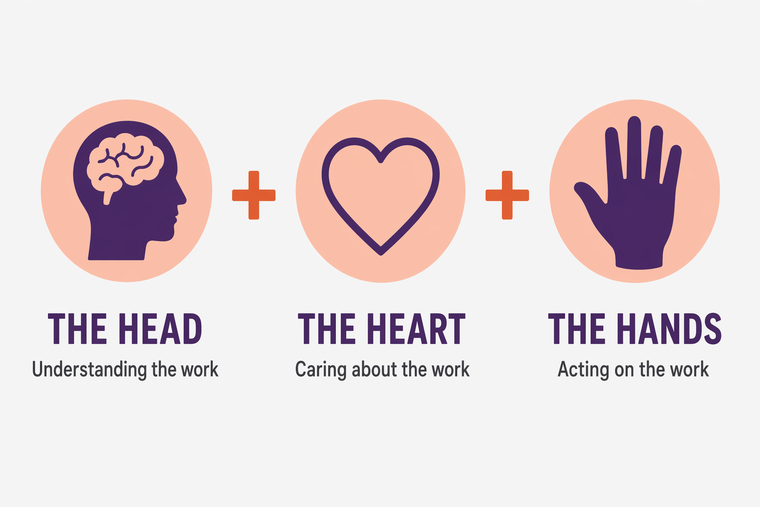
An employee with only the head is compliant but not creative. They know what to do, but they won’t go looking for better ways to do it.
An employee with the head and the hands but no heart is productive in the short term and heading for burnout in the long term. You can recognize them. They deliver right up until the day they quit.
When all three are present, you get employees who stay because they want to, not because they have to. That’s what lasting dedication looks like, and it’s what a good engagement program is actually trying to produce.
Two retention drivers that most engagement programs still undervalue
If head, heart, and hands describe what engagement looks like, two specific drivers explain whether employees truly experience it. They’ve emerged consistently in research since 2020, and most engagement programs still haven’t caught up.
In our work with Northeast Ohio employers across manufacturing, healthcare, and non-profit sectors, we see these two drivers separate organizations whose engagement scores improve from those that stall.
Employee well-being
The first is employee well-being. Sam defines it simply as “how am I doing?”
Well-being covers:
- Physical and mental health
- Workload
- Trust in management
- Work-life balance
- Social connection
- Financial stability.
Not every employer can offer unlimited PTO or on-site therapy, but every employer can think about reasonable deadlines, the ability to unplug after hours, and real support when workload spikes.
ERC’s NorthCoast 99 data shows how seriously low-turnover organizations take well-being. Among Top Workplace Award-winning organizations with less than 10% turnover:
- 96% offer an Employee Assistance Program
- 94% regularly check in with employees about work-life balance
- 92% regularly check in about mental health
- 92% offer a health insurance plan with mental health coverage
- 85% provide access to telehealth counseling.
Well-being is a formalized practice in top organizations.
It’s also important to consider the post-COVID environment. Well-being used to be positioned as a perk. It’s now part of the foundation. Employees evaluate it the way they evaluate compensation. If you underdeliver, you don’t just lose a bonus differentiator. You lose the person.
Psychological safety
The second driver is psychological safety. Sam defines it as “how safe I feel speaking up.”
It shows up in small, everyday moments:
- A junior team member challenging a process without getting punished for it
- As colleagues debating a decision without personal attacks
- A leader admitting a mistake so everyone else knows they can too
ERC’s own data backs this up. Top-performing employees inside Top Workplace Award-winning organizations average engagement scores of 96% alongside psychological safety scores above 90%. The two move together. When psychological safety is present, engagement follows.
Both well-being and psychological safety are measurable. Both sit upstream of retention. And both are most useful when assessed regularly, not once every few years.
Why retention is not the same as loyalty
Kaylyn Hampshire made the sharpest distinction in our panel, and it’s one we wish more leadership teams understood. Retention and loyalty are related concepts, but they answer different questions.
Retention is behavioral. It answers one question: did the employee stay?
It’s useful because it’s concrete and easy to put on a scoreboard. But it doesn’t tell you why someone stayed. Some employees stay because they believe in what they’re building. Some stay because they’re afraid of change, or because they need the paycheck, or because they don’t see another option right now.
Loyalty is attitudinal. It reflects how invested an employee feels. Loyal employees align with the company’s values.
They want to contribute, advocate, and help the organization succeed. And here’s the nuance: a loyal employee might eventually leave, and they will still speak well of the organization on their way out. A non-loyal employee who stays is someone who feels stuck, and the organization is going to pay for that eventually.
Most engagement measurement misses this distinction. The Employee Net Promoter Score (eNPS) is a useful instrument for surfacing it. It asks one direct question: how likely are you to recommend working at this company to a friend or former colleague?
Scores of 9 and 10 mean promoters. Scores of 0 through 6 mean detractors. Scores of 7-8 represent passives. eNPS tends to sit lower than other engagement metrics by design. Passive satisfaction doesn’t earn advocacy.
For an HR leader who needs to explain to the executive team why retention numbers alone aren’t a complete picture, this is the framework. Retention tells you what happened. Loyalty helps explain why. Sustainable retention requires strengthening the attitudes underneath the metric.
Why most engagement surveys fail to change anything
Many of the HR leaders we talk to have run an engagement survey before. A good portion of them will quietly tell us the last one didn’t lead to meaningful change.
This isn’t a problem with the surveys themselves. It’s a problem with how they’re used.
Organizations that collect survey data and fail to act on it erode trust faster than those that never ran a survey in the first place. Listening without following through is a signal in itself.
There are a few specific patterns we see, and we cover these in more depth in our introduction to employee engagement surveys. The short list:
- Unvalidated questions. A lot of organizations now build engagement surveys from Google results or AI-generated questions. If those questions haven’t been validated through advanced statistical analyses, such as factor analysis and reliability testing, they’re not accurately measuring engagement. You could take action on the results and make things worse.
- Treating engagement as a one-time event. Engagement is a cycle: ask, interpret, act, repeat. A one-and-done survey produces data and then lets it expire. Employees notice that.
- Assuming technology replaces expertise. Platforms and dashboards are useful. But neither knows what’s happening inside your organization. Expert interpretation, the part where someone says “here’s what the data is telling us and here’s what we’d recommend,” is where the real change comes from.
- Skipping guided action planning. The survey is the start of the work, not the end of it. Without an action plan, the data stays data and never becomes progress.
The strongest surveys are paired with a clear follow-up structure and an expert who can interpret the data.
How to move from intuition to measurement
If you’ve read this far, you probably already have a sense of where your organization sits.
If you want a clearer picture of where your organization stands across engagement, well-being, psychological safety, and loyalty, a more structured measurement approach can help
Our engagement team at ERC works with leaders across Northeast Ohio, helping them understand what’s driving engagement and turning that insight into stronger retention outcomes. We’d be glad to walk you through what a survey could surface in your situation.
Samantha Vance is Manager of Surveys and Research at ERC. Kaylyn Hampshire is a Research Associate at ERC. Both are industrial-organizational psychologists. If you’re an HR leader or business owner in Northeast Ohio and you’re thinking about engagement, let’s talk. Learn more about our engagement survey and consulting work.

