
What happens when pay rises without a clear link to performance, role growth, or business impact? Organizations start paying more but getting less in return.
Payroll costs climb faster than results. Employees remain highly compensated for responsibilities they no longer carry. Raises get approved because they feel easier than addressing performance issues.
Over time, compensation stops driving the business forward. Instead, it drains budget, frustrates top performers, and creates costly problems that take years to unwind.
The question is: how do you realign pay with performance before the gap becomes too expensive to fix?
The Problem is Usually the Pay Structure
In most cases, this isn’t caused by one bad decision. It’s the result of slow, unexamined drift.
Roles evolve or don’t. Responsibilities shift. The business changes. But compensation decisions continue on autopilot.
Over time, organizations lose alignment between:
- What a role is worth
- What an employee contributes
- What the business actually needs
A single raise rarely looks like a problem. But repeated over time, those decisions quietly reshape the entire compensation structure.
That’s how organizations end up overpaying for roles that no longer justify their cost.
How Overpaying for Underperformance Shows Up
It’s important to know where compensation problems show up so you can catch them before they turn into larger financial, retention, and performance issues. Here are the patterns to watch.
1. Pay grows, but the role doesn’t
An employee stays in the same role for years. Responsibilities don’t expand. The job isn’t redefined. But pay continues to increase.
This is one of the clearest ways compensation outpaces contribution. Not due to poor performance, but because the role itself was never reassessed. Operational roles like Office Manager often fall into this trap.
2. Pay reflects a broader role than the employee is performing
Sometimes the job has quietly narrowed, but the pay hasn’t.
An employee may still be compensated as if they oversee a function, team, or strategic area even though their current scope is smaller.
At that point, the issue isn’t just pay. It’s role clarity.
In some cases, the right move is to expand the role. In others, it’s a mismatch between the role and the person. But ignoring it allows the gap to grow.
3. Incentives reward activity, not outcomes
Incentive plans often default to what’s easy to measure: effort, volume, or visibility.
But when pay is tied to activity instead of impact, compensation increases without corresponding results.
Over time, employees learn a simple lesson: what gets paid isn’t always what matters most.
We see this kind of disconnect when pay growth is no longer tied closely enough to accountability or real performance.
4. Raises replace performance management
This is one of the most common and costly patterns.
Managers avoid difficult conversations about performance, accountability, or role stagnation. A raise feels easier.
But repeated across a team, this becomes expensive quickly.
Compensation is no longer reinforcing performance. It’s masking the absence of it.
5. The business changes, but pay practices do not
Automation. AI. Organizational shifts. Changing customer demands.
Roles evolve constantly. But many compensation practices don’t keep up.
Pay continues as if the work is unchanged, even when the value of the role has shifted.
This is also where you start to see organizations hiring externally for higher-level roles because internal talent hasn’t been developed.
Why This Matters to Organizations
This isn’t just an HR issue. It’s a business performance issue, and it typically shows up in four ways.
1. Higher labor costs without better results
This is the most obvious problem. Payroll grows, but output doesn’t improve at the same pace. In some cases, leaders don’t realize how large the gap has become until they finally review the numbers and discover that fixing it will require a multi-year plan.
2. Retention risk in the wrong places
Misaligned compensation rarely affects only overpaid roles. It often exists with underpaid high performers elsewhere in the organization.
That is where the financial risk becomes strategic. The employees you want to retain most may be the ones most likely to leave when the market shifts, while money remains tied up in roles that are not moving the business forward.
Once leaders do the math, the underpayment side of the equation often proves just as serious and expensive.
3. Erosion of fairness and trust
Let’s be honest: employees don’t need access to your organization’s salary database to sense when compensation isn’t fair.
They notice when pay seems disconnected from contribution. They notice when stagnant roles are protected. They notice when growth isn’t rewarded consistently.
Once that perception takes hold, compensation stops feeling like a system and starts feeling arbitrary. That can affect morale, trust, and manager credibility long before it shows up in turnover data.
4. Strain on leadership capacity
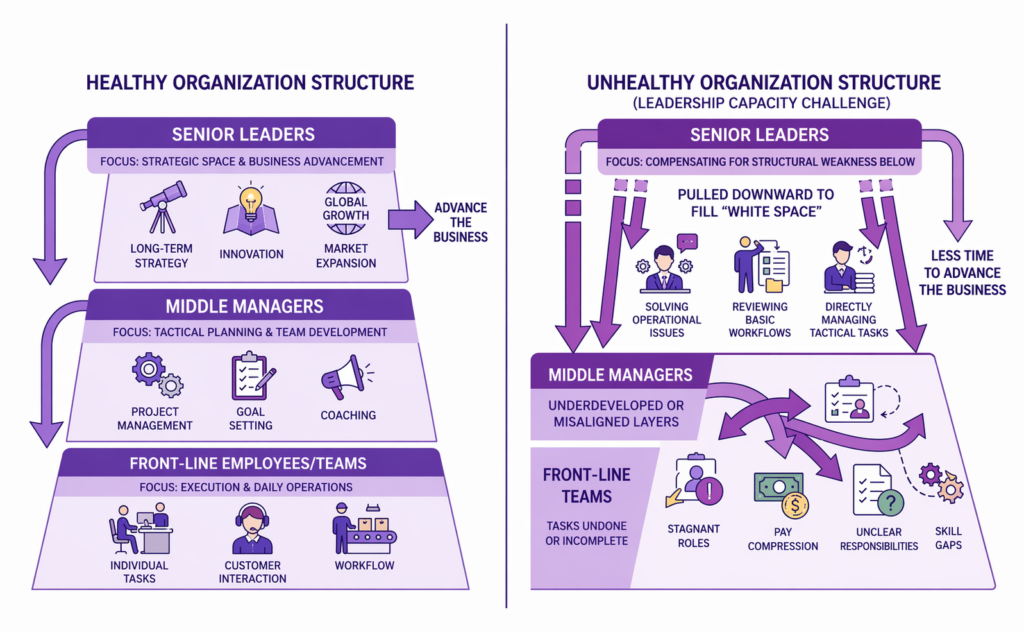
We often see stagnant roles and pay compression create what we think of as “white space” problems in the organization.
In a healthy structure, leaders fill the strategic space appropriate to their level. In an unhealthy one, leaders get pulled downward, spending time on work that should be owned lower in the organization because the layers below them are underdeveloped or misaligned.
The result is that senior leaders have less time to advance the business because they are compensating for structural weakness below them.
What to Do If You See the Problem
The good news is that fixing this is usually straightforward in concept. Here’s what employers can do:
- Update roles and accountabilities: Start by clarifying core functions and accountabilities. If the business has changed, the role needs to reflect that.
- Market price jobs against the work being done: Do not benchmark against what a role used to be, what the title sounds like, or what you hoped it would become. Benchmark against the actual scope and responsibilities.
- Strengthen performance management: If pay is going to reinforce results, managers need a system that clearly defines goals, values, and accountability. Otherwise, compensation decisions will continue to drift.
- Separate the reasons money gets allocated: Treat different types of pay decisions differently. Cost-of-living adjustments, merit increases, promotional increases, and off-schedule adjustments should not all come from the same financial bucket. A promotion increase should not be handled like a routine merit increase, and a market correction should not be treated like a reward for performance.
- Build a glide path, not a panicked reaction: If the issue has built up over years, it usually cannot be fixed in one compensation cycle. In our experience, many organizations need a two- to four-year glide path, with different strategies for different groups of employees depending on urgency, performance, and future role plans.
Key Takeaways
Overpaying for underperformance is rarely just a compensation issue. It signals misalignment between role design, accountability, development, and pay.
The result: organizations overpay in some areas, underinvest where it matters most, and make it harder for leaders to move the business forward.
The goal isn’t to make compensation more rigid. It’s to make it more intentional. When aligned correctly, compensation drives performance instead of funding its opposite.
If you’re concerned that compensation decisions are creating cost, equity, or performance issues, let’s talk. We help organizations review roles, benchmark jobs against actual responsibilities, and build compensation strategies leaders can defend and implement with confidence.

