
If HR in your organization is currently “owned” by a mix of leaders, office/admin staff, finance, or operations, or you’re feeling the growing pains of not enough HR capacity, this guide is meant to help you decide what to do next.
The two next steps we’re going to explore are:
- Make a permanent HR hire, or
- Bring in fractional HR (part-time, senior HR support) to build the foundation and steady the day-to-day.
Download the decision guide as a PDF to use it as a reference or a worksheet.
1) HR Self-Assessment: Are you ready to invest in HR?
Most organizations don’t just decide they “need HR.” Use the checklist below to spot the most common signs that it’s time.
A. Leadership bandwidth is getting consumed
Check any that are true:
- Leaders or non-HR employees are spending time on employee issues, hiring decisions, policy questions, or “what do we do in this situation?”
- You’re making decisions without an HR expert (terminations, leave requests, accommodations, pay changes), and you’re not confident you’re doing it right.
B. Hiring and onboarding feel inconsistent (and too slow)
Check any that are true:
- Job descriptions and interviews aren’t standardized, so the process varies depending on who’s involved
- You’re not sure what’s fair (or legal) to ask in interviews, and you don’t have clear guidelines
- Onboarding isn’t a consistent process (role expectations, training, and early check-ins vary by manager/team)
- Open roles are staying open longer than you want because your team doesn’t have the capacity to recruit and hire efficiently
C. Compliance and policies feel unclear, outdated, or risky
Check any that are true:
- Policies are outdated, copied from somewhere else, applied inconsistently, or you don’t have a handbook/policies documented at all
- You’re not sure what you’re required to do (or document) to stay compliant, especially around leave, wage/hour, and terminations
- If a sensitive situation comes up (a complaint, a leave request, a termination), you don’t have a clear, documented process for what happens next
D. Employee issues are showing up more often
Check any that are true:
- Turnover is rising, or you’re seeing “avoidable exits”
- Managers aren’t consistent in expectations, feedback, or documentation
- You’re noticing morale issues or conflict that isn’t being addressed early
E. Growth is creating complexity faster than your systems can keep up
Check any that are true:
- You added layers (team leads, managers) but didn’t add HR processes to match (hiring, onboarding, performance, documentation)
- You’re adding benefits, new roles, new locations, or new shift structures
- Compliance tasks are becoming a constant interruption (documentation, required postings/filings, staying current with changing rules)
F. You’re facing (or anticipating) a coverage gap
Check any that are true:
- The person responsible for HR is leaving or going on leave
- You’re about to grow quickly (new contracts, new funding, seasonal hiring surge)
- You’re planning to hire HR eventually, but you need the foundation in place first (policies, documentation, hiring/onboarding basics) so that the hire can succeed
Scoring
Treat each line above as a checkbox.
- If it’s true for your organization, check it and give yourself 1 point.
- If it’s not true, leave it unchecked (0 points).
0–5 points: You may not need a dedicated HR role yet. Even at this stage, you still need reliable HR resources and expertise, just not necessarily a full-time hire. Many organizations here do best with structured HR guidance and on-call support (for example, ERC membership) while they keep building the foundation. Revisit this in 60–90 days.
6–11 points: You’re likely ready for part-time HR support. You’re starting to see repeat problems that are slowing leaders down and early risk signals like missed documentation, uncertainty around leave/compliance, or inconsistent handling of sensitive situations. This is a good time to bring in part-time help, either fractional HR or a part-time HR hire, and map what “better HR” should look like for the next 6–12 months.
12+ points: You need dedicated HR help.
The cost of “doing HR” as an extra responsibility for someone who already has another full-time role is likely showing up in leadership distraction, inconsistency, or compliance exposure. It’s time to choose a model and put a plan in motion.
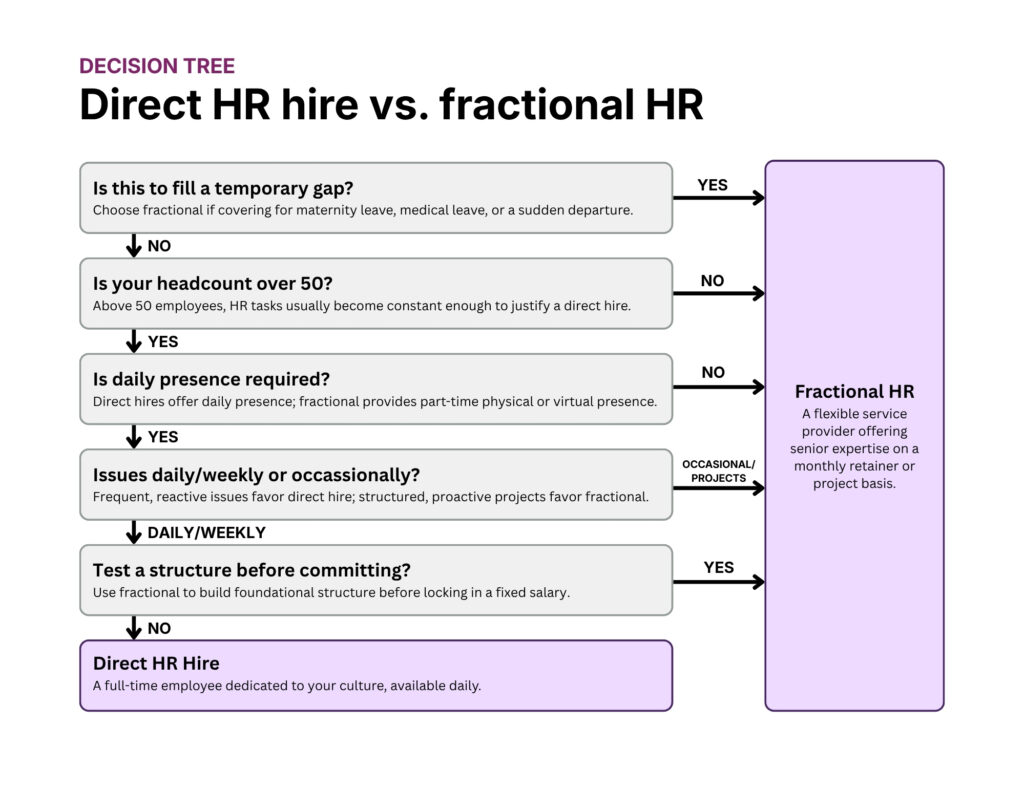
2) Decision Tree: Permanent HR hire vs. Fractional HR
3) What comes next? How HR models evolve as you grow
The “right” HR model now doesn’t mean it will be the right HR model in the future. Planning for that evolution is part of building a real HR function.
Common transition paths
Path A: Fractional HR → Internal HR hire
This is common when fractional HR builds the foundation, stabilizes compliance, and creates repeatable processes, then you bring in an internal HR professional to run them.
Typical timeline:
- Common “bridge to first hire” window: in our experience, fractional HR is most often a ~3–4 month bridge to recruiting, hiring, and onboarding your first HR employee.
- In more complex environments (multi-state, heavy compliance needs, rapid hiring), fractional support may stay in place longer.
Triggers that often signal it’s time to bring in fractional HR as a bridge before your first HR hire:
- You’ve decided to make your first HR hire within the next ~6-12 months, but you want experienced support in the interim.
- You want help scoping the role (what this first HR hire should own vs. what should stay with leaders/operations) and getting ready to recruit (job description, selection criteria, interview process).
- You want your first HR hire to walk into a function that’s set up to succeed, so fractional HR can build the essentials now while the hire is being recruited and onboarded.
Path C: Internal HR (generalist/manager) and Fractional HR support
This approach can make sense when you want day-to-day HR ownership internally, but your internal HR generalist or manager needs added support, extra capacity, or specialized expertise for higher-risk or time-bound work:
Typical timeline:
- Fractional support is often brought in temporarily or in the interim to help stabilize or extend capacity (for example, during an employee leave, an HR transition, or a period where needs exceed internal expertise).
Triggers that often signal a hybrid approach:
- You already have an internal HR owner, but you need senior support for complex or higher-risk work such as investigations, terminations/leave guidance, or compliance cleanup.
- You have a temporary coverage gap (leave, turnover, reorganization) and need experienced HR support so managers and employees aren’t left without guidance.
- You have a time-bound spike or project (rapid hiring, new state/location, policy overhaul, handbook overhaul) and need extra capacity/expertise without adding another full-time role.
Conclusion
The right HR move depends on where your organization is today, how much risk and complexity there is, and whether you need someone to build the function, run it day-to-day, or help bridge the gap.
Use your self-assessment score and the decision tree together to identify the model that fits now. Then, outline what actions to take next so you can move forward with the right level of support, structure, and flexibility.

