
Employee Engagement Consulting
When turnover is climbing, morale is slipping, or engagement feels off after changes internally, you need more than just employee satisfaction numbers. We measure employee engagement, interpret what your team is telling you, and build recommendations that your team can act on.

30-Minute Employee Engagement Consultation
Talk through your employee engagement challenges and get practical answers and advice from an expert.
Our Employee Engagement Methodology & Process

1
Measure
A fully managed survey, anonymous, built around the questions you need answered.

2
Interpret
Your results translated into plain language and benchmarked against other organizations.

3
Plan
A specific roadmap built for your team and your situation.

4
Present
We walk your team through the findings and connect findings to the work that follows: training, consulting, and support.
We Don’t Just Run Surveys,
We Help You Identify What Matters and Take Action
We stay with you from survey design through implementation and next steps.
Unlike providers or technology platforms that give you a report or a dashboard and walk away, we work alongside you. We explain what your data means compared to other organizations and guide you through action planning so you know exactly where to focus.
Surveys Proven to Predict Engagement
When you work with ERC, you get validated, proven survey questions that actually predict engagement. We help you understand what the results mean in the context of your specific challenges, whether that’s turnover in a particular department, culture concerns after organizational change, or leadership effectiveness issues.
How We Do It
Expert Interpretation and Actionable Recommendations
We don’t hand you a report and disappear. Our experts analyze your results, benchmark them against hundreds of organizations and thousands of employees in our database, and walk your leadership team through what the data means and where to focus.
How We Do It

We Handle Everything (and Connect You to Real Solutions)
From kickoff to action plan, we manage the entire survey process so it’s easy for you. And when results point to specific needs, we can connect you to training, consulting, or other solutions to address what you’ve uncovered.
How We Do It
How RosmanSearch Used an Employee Engagement Survey to Guide the Organization through Growth
RosmanSearch partnered with ERC to run an employee engagement survey to get a clearer picture of how employees were feeling and where leadership may need to pay closer attention.
When is Employee Engagement Consulting the right fit?
Exit interviews tell you part of the story. The people still on the team know the rest. We run the survey, look for patterns in what they’re telling you, and bring back a clear picture of what’s driving the door to keep opening.
Major changes leave a mark. Sometimes the work is about giving your team a structured place to say what they’re feeling. Sometimes it’s about giving leadership the data to act on instincts they’ve already had. We help you separate the two.
The instinct is usually right. Leaders who feel a culture shift early are reading signals their managers haven’t reported yet. We help you confirm or correct what you’re seeing before you spend budget on the wrong fix.
Engagement work doesn’t have to be reactive. Some of our strongest engagements start with a leadership team that wants a baseline to build from, an honest read on what’s working, and a plan that compounds over time.
CEOs, boards, and parent companies ask for engagement data. A homegrown survey rarely carries the weight you need. We give you third-party benchmarks, anonymous responses, and a presentation-ready picture of where the organization stands.
Most of our new engagements start here. A previous vendor delivered a report and ended the conversation. We run the survey, interpret what your team is telling you, and stay through the part where the findings turn into a plan.
Combining two cultures is hard work, and the people side often gets the least planning. We help leadership teams understand both cultures from the inside, so the integration plan reflects what your employees are telling you rather than what the deal memo assumed.
What’s Measured
12 Research-Backed Predictors of Employee Engagement
Our employee engagement surveys are grounded in validated research and a proven methodology. We measure the employee experience factors that actually drive engagement so your results are reliable, clear, and easy to act on.
Every category we measure is tied to what matters most: helping your people stay connected, motivated, and performing at their best.
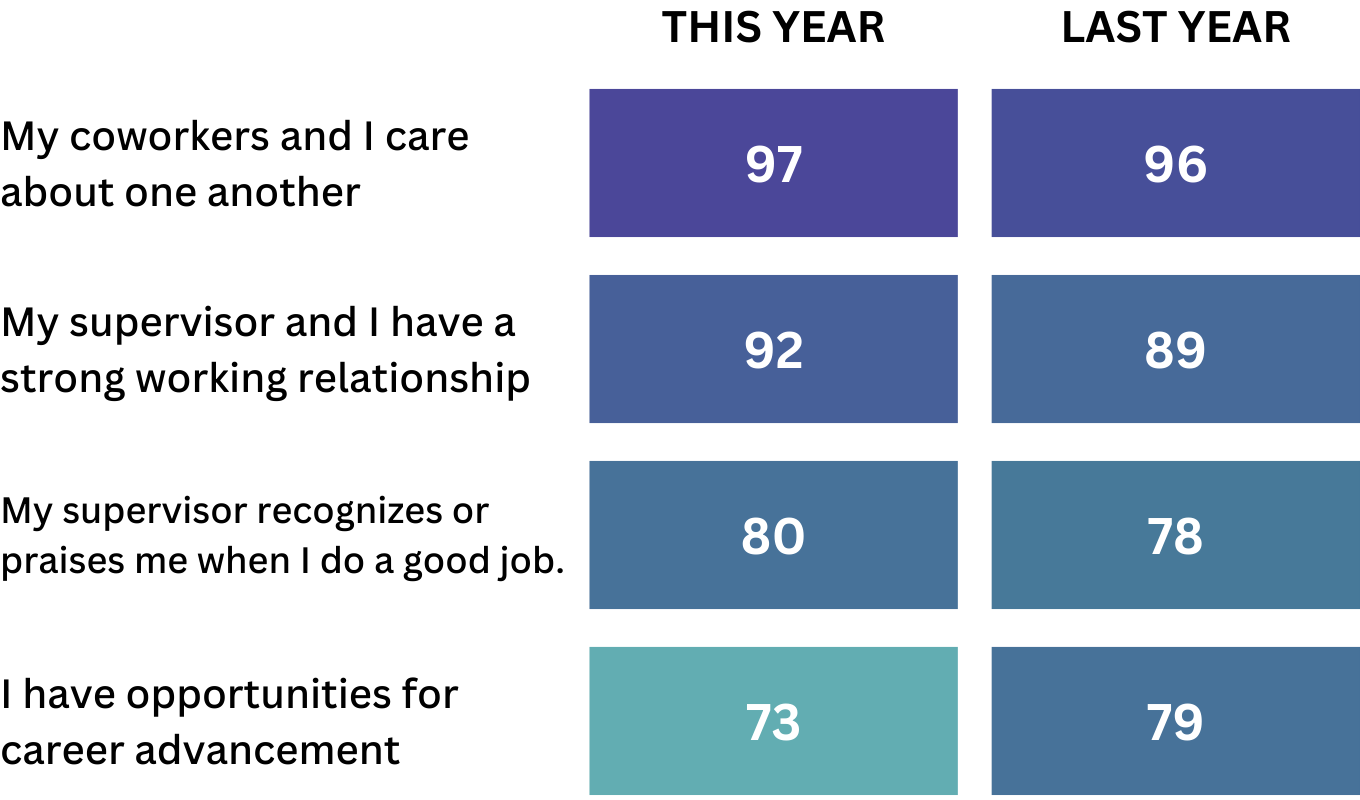
Leadership
How employees perceive organizational leadership and direction
Job Design & Challenge
Whether work is meaningful, interesting, and appropriately challenging
Training
Access to development opportunities and skill building
Recognition & Rewards
How employees feel valued and appreciated
Supervision
Quality of direct manager relationships and support
Psychological Safety
Ability to speak up, take risks, and be authentic
Coworker Cohesion
Team dynamics and peer relationships
Value & Innovation
Feeling heard and able to contribute ideas
Performance & Alignment
Clarity on expectations and connection to company goals
Growth & Development
Career progression and learning opportunities
Autonomy
Freedom to make decisions and control how work gets done
Overall Employee Engagement
Commitment, enthusiasm, and discretionary effort
Measurement Tools Matched to Your Goals
We offer multiple tools for measuring engagement depending on how deep you want to go. Not sure which one is right for you? We’ll help you decide based on your goals, timing, and what you’re trying to understand.

Standard Survey
Best for: Comprehensive, annual or bi-annual insights
Measures engagement drivers, culture, leadership, and overall employee experience
Ideal for establishing baselines and informing long-term strategy

Pulse
Best for: Quick feedback
Short, targeted surveys used throughout the year
Helps organizations monitor progress and respond quickly

eNPS
Best for: Employee loyalty and advocacy
Simple, powerful measure of how likely employees are to recommend your organization
Often paired with open-text feedback for deeper insight
Our Employee Engagement Consultants

Susan Pyles
Susan has more than 20 years of achievements in talent management and assessment, performance management, employee experience, HR analytics, leadership development, coaching, and workforce planning.
She is a member of the HR Leadership Group and carries nearly a dozen certifications, including Myers–Briggs Type Indicator® (MBTI®): Step I™ & Step II™, DiSC, 360 Leadership Assessment (Zenger Folkman), Emotional and Social Competency Inventory (The Hay Group), and Predictive Index

Samantha Vance
Sam works with data to provide employers with insights into practices that create and support great workplaces. She manages both internal and client surveys and is a key contributor to our employee engagement practice.
Sam earned her master’s degree in industrial-organizational psychology research from Cleveland State University. She holds a bachelor’s degree in psychology and a minor in business administration from Ohio University. Sam is certified in 21st Century Leadership.

Kaylyn Hampshire
Kaylyn analyzes data to provide organizations with insights into practices that build and support great workplaces. She designs, administers, and interprets surveys and assessments.
Kaylyn earned her master’s degree in industrial organizational psychology from the University of Akron and her bachelor’s degree in psychology from the University of Central Florida.
Frequently Asked Questions (FAQ)
A DIY survey or a software platform gives you data and a dashboard. We give you the data, what it means for your organization, a plan for what to do next, and a leadership presentation that helps you get buy-in for the plan. The survey is one step in the work, not the whole engagement. Clients who’ve tried major survey platforms often tell us the same thing afterward: the results were interesting, but nothing changed because no one translated the numbers into specific actions for their team. That translation is the part we focus on.
The action plan ties your survey findings to specific recommendations for your team. We organize by engagement driver (leadership, recognition, communication, growth, and the other categories our framework measures), then prioritize by impact and effort. For each recommendation, we identify what your leadership team can act on directly, what needs a manager-level program, and what calls for a broader investment like training, a policy change, or a compensation review. You leave with a sequenced roadmap and clear ownership, not a list of suggestions sitting in a deck.
After the survey closes, we analyze results, prepare your findings document, present to your leadership team, and hand off the action plan. From there, many clients move into the next phase of work with us. The survey often points to a clear next step, whether that’s supervisor training (when leadership scores are the issue), fractional HR support (when policies, processes, or capacity are getting in the way), or compensation work (when fairness shows up as a driver). We stay connected through whatever comes next, so the work the survey kicked off doesn’t lose momentum.
Most engagements run 8 to 12 weeks from kickoff to leadership presentation. Survey design and setup take about two weeks, where we work with you on the questions, audience segments, and communication plan. Fielding runs two to three weeks depending on company size and how quickly your team responds. Analysis and reporting take three to four weeks. We adjust the timeline to fit your reporting cycle, board calendar, or merger close date when needed, and we can move faster when something urgent is driving the conversation.
A lot of clients come to us after a previous survey effort stalled. The most common reason is that the previous vendor delivered a report and ended the engagement. Sometimes the data was good, but no one translated it into specific actions, owners, or timelines. Other times the survey itself wasn’t designed around the questions leadership needed answered. We organize the work around what happens next. Leadership gets a plan with clear priorities, managers get something to do with their teams, and the survey becomes the start of the work rather than the end of it.
Yes. Our benchmark data draws from organizations across manufacturing, healthcare, nonprofits, and professional services. National benchmarks compare your scores to companies you’ll never lose talent to, which makes them interesting context but rarely a decision driver. Our benchmark compares you to the employers your people are weighing offers from across the street. For Northeast Ohio organizations, that’s a more useful read on where you stand, especially when retention or recruiting is part of the conversation.
The patterns we see most often are supervisor effectiveness, recognition, communication from senior leadership, and growth and development. Compensation surfaces less often than people expect, and when it does, the conversation usually centers on fairness and transparency rather than absolute pay levels. Industry shifts things at the edges. Manufacturing engagement scores tend to hinge on supervisor skill and front-line communication. Healthcare scores often track to workload and recognition. Nonprofits trend toward mission alignment and growth opportunities. Supervisor effectiveness sits at the top across nearly every Northeast Ohio organization we work with, which is why most of our action plans start there.
Get Pricing or More Information
Get pricing for ERC’s Employee Engagement Consulting and Surveys. Have questions? Speak with an expert to learn more.
